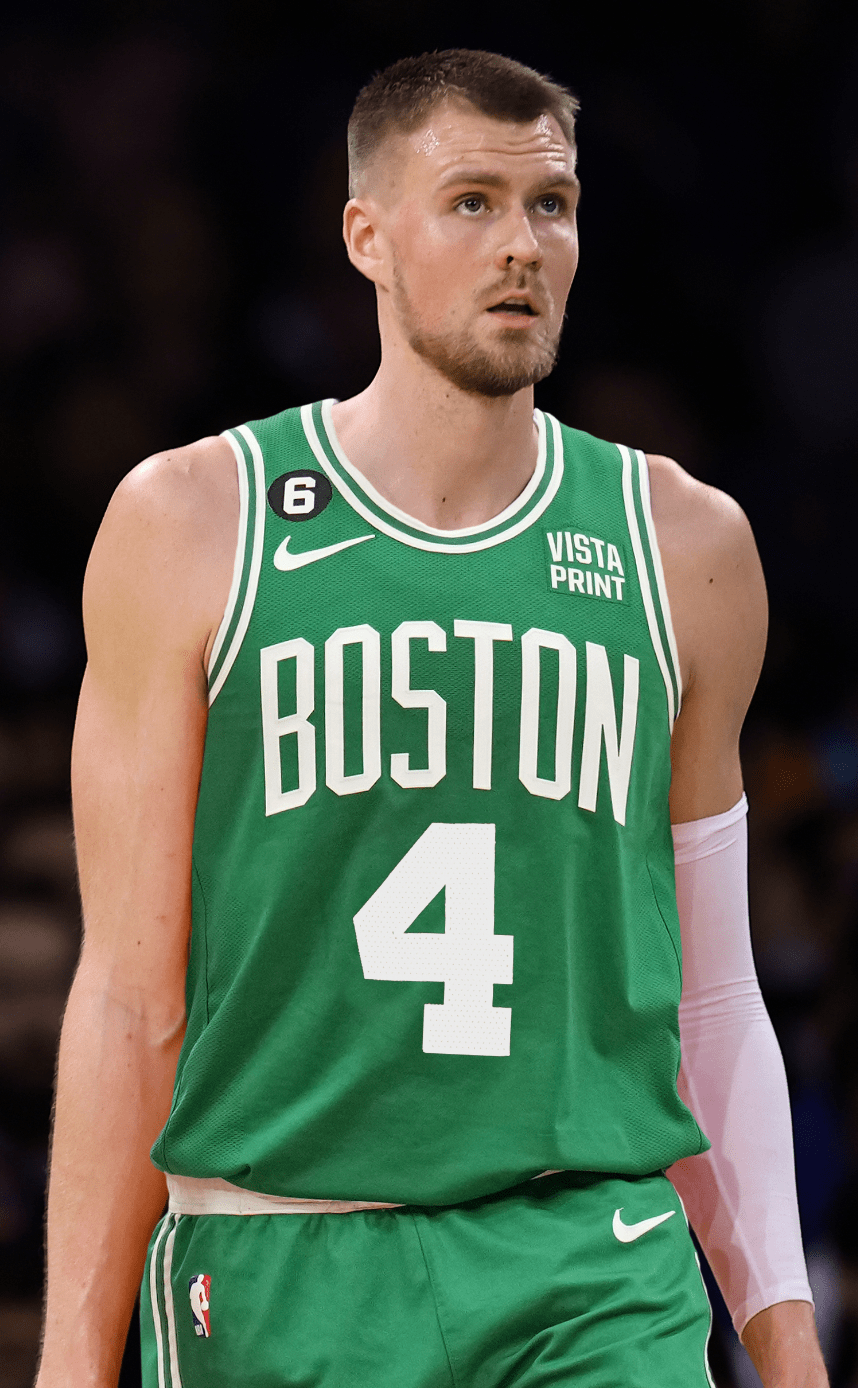
I’ll admit, it took some time for me to get on board with this trade. But, oh boy, am I on board now.
Although I am still very sad to see Marcus Smart go, Boston’s return of Kristaps Porzingis and multiple picks ultimately make the Celtics a more balanced and better team overall. The trade allowed the Celtics to clear up a logjam in the backcourt, while improving in the frontcourt and alleviating stress on Boston’s big man duo of Al Horford and Robert Williams.
For the first time in his career, Porzingis will be tasked with operating as a third offensive option, after stints in New York, Dallas and Washington saw him as either the guy or as a No. 2 option. His most recent stops with the Mavericks and Wizards saw Porzingis play behind stars Luka Doncic and Bradley Beal, though Porzingis also saw opportunities as the No. 1 option in Washington with injuries to Beal allowing him to have a larger role in several games.
Porzingis enjoyed a career renaissance last season with the Wizards after struggling to make the pairing alongside Doncic work in Dallas. There were several factors that doomed Porzingis in Dallas, with availability being one of the biggest setbacks for the Latvian big man as he played in less than 60 games in each of his two full seasons as a Maverick due to knee complications. While in Dallas, Porzingis largely turned into a spot up shooter, with physical limitations hampering his ability to create for himself and others.
In Washington, Porzingis appeared to play with much more freedom than he did with the Mavericks. He became a staple of the Wizards’ offense with his solid shooting off the catch, and prowess as a shot creator and passer out of the high post. Porzingis boasted a career-high 23.2 points per game while shooting 49.8 percent, also a career-best mark, and 38.5 percent from three-point range, in his lone season as a Wizard.
Porzingis’ potential offensive impact for the Celtics cannot be understated, with him providing Boston with a dynamic high-post option that could allow it to expand its mid-range opportunities after the Celtics’ relied heavily on the three-ball and paint points last season. I love what Porzingis brings as a player out of the high post, where he initiated much of his offense and showed himself to be a worthy passer out of last season with the Wizards.
Porzingis’ post-up prowess is a new addition to his game, with his lone season in Washington serving as a breakout in that regard. With the Wizards last season, Washington averaged 1.18 points per possession when Porzingis would post up — which puts him in similar company with Nikola Jokic (1.22 PPP) and Joel Embiid (1.13 PPP). That added wrinkle to his game could be incredibly helpful for a Celtics frontcourt which hardly relied on postups last season, with Horford serving as a more of a catch-and-shoot threat and Williams as an above-the-rim scorer.
While an improved post presence, Porzingis also offers a solid option as the roll man on pick-and-rolls, also posting 1.18 points per possession for Washington as a roller last season. Porzingis’ three-point shooting ability also allows him to be effective in pick-and-pop scenarios as well.
In the immediate aftermath of the trade, I’ll admit that I was concerned about a potential drop off on the defensive end of the floor, with Boston losing one of the league’s best perimeter defenders and a former Defensive Player of the Year in Smart. With Porzingis swapping in for Smart, Boston will certainly have to change its defensive approach, however, I don’t expect to see a massive drop off on that end of the floor this season after digging deeper into what Porzingis provides defensively.
While I don’t see a major drop off in terms of defensive efficiency, I do see Boston playing differently on that end of the floor. The Celtics lost a decent bit of their defensive versatility by swapping Smart for Porzingis, with Smart carrying the ability to switch onto guards, forwards and centers. Boston will still be switch-heavy with Porzingis in tow, but with Porzingis’ 7-foot-3 frame and limited mobility, I don’t expect to see Joe Mazzulla switch everything in lineups with Porzingis on the floor.
Porzingis’ inclusion to Boston’s defensive scheme is a welcome one, as he can provide the Celtics with a true rim protector in ways that Horford or Williams haven’t been able to consistently produce. Last season with the Wizards, Porzingis held opponents to 53.5 percent shooting within six feet of the cup, producing better marks than Rudy Gobert (56.8 percent), Embiid (63.2 percent) and Evan Mobley (57.5 percent), to name a few.
Although Boston won’t be able to switch as much on defense, the Celtics could benefit immensely from the rim protection potential provided by Porzingis.
Now, I do still have some lingering concerns surrounding the trade.
Porzingis’ availability is concerning, with him playing more than 60 games in a season just once since 2016-17. On the bright side, he did play 65 games last season and looked generally healthier than he did in Dallas, though his knees are going to remain a concern throughout next season and beyond.
Another issue I have with this trade is Boston trading its best playmaker despite already being limited in that department. The Celtics haven’t quite had a floor general-type point guard in some time — perhaps as far back as Rajon Rondo — and Smart was by no means that type of guard, but he did lead Boston in assists in each of the last two seasons while operating as the starting point guard. Now, Boston is left without a true facilitator, with the hopes that Derrick White can develop that side of his game — and I have a ton of confidence he will do so, though it’s still a concern entering the season.
Overall, though, I do believe the positives outweigh the negatives in this deal and I’m slowly beginning to get excited about the prospect of Porzingis in green.
Photo Credit: ESPN
 Writing Roundball
Leave a comment